How to read a supplement label, line by line
Serving size, %NRV and %DV, compound versus nutrient amounts, and what quality certificates do and do not tell you.
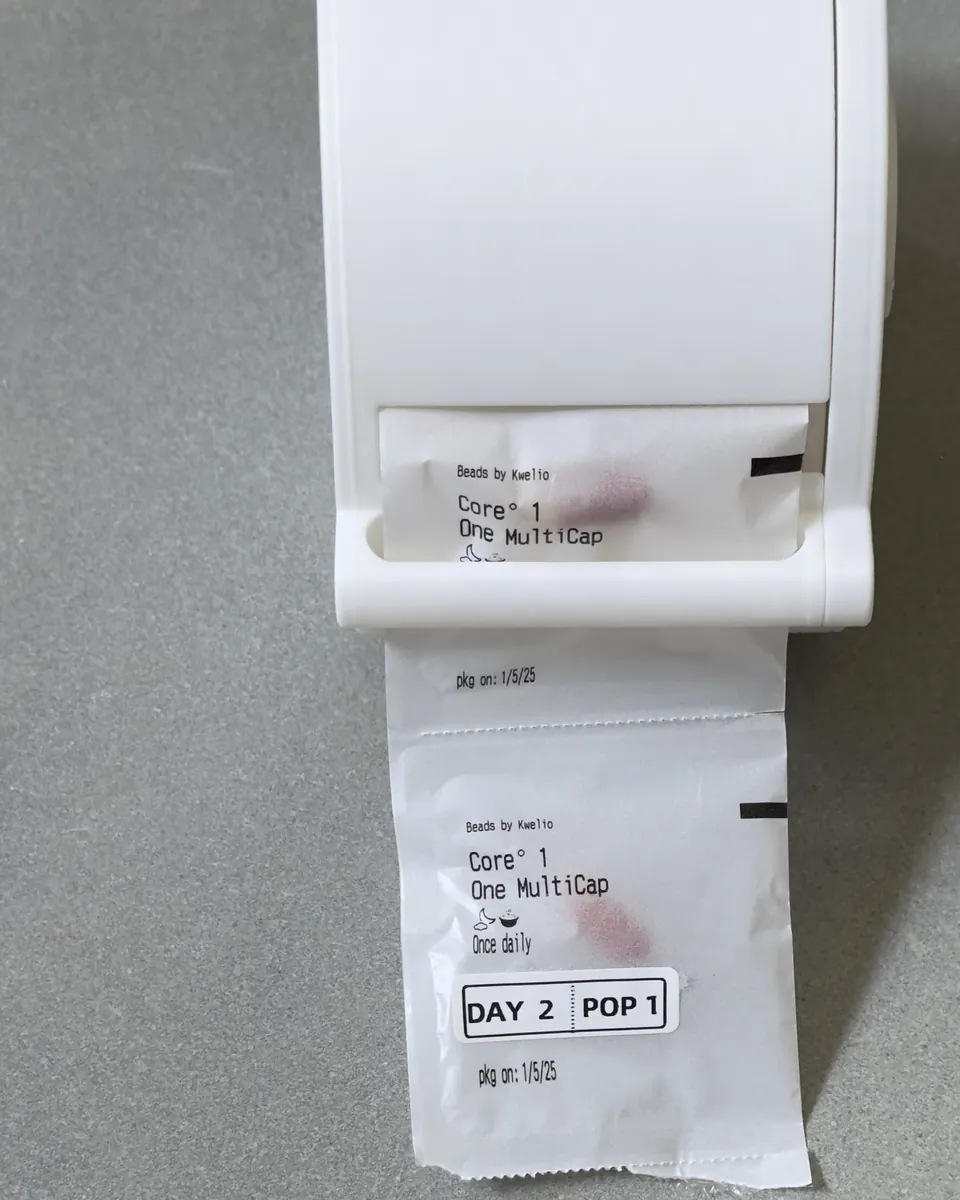
Start with the serving size
Every number on a supplement label refers to a set amount of product. Under EU law, the label must state the portion recommended for daily consumption, with a warning not to exceed it1. The nutrient amounts are then given for that daily portion1.
US labels call this the serving size. The US Food and Drug Administration (FDA) defines one serving as the most the label recommends per eating occasion. If there is no recommendation, a serving is one unit, such as one capsule2.
So read the serving line first. If a serving is two capsules, every amount on the panel is for two capsules, not one.
Amount per serving, %NRV and %DV
The amount column shows how much of each nutrient one serving provides. EU law requires these amounts as numbers, in set units such as milligrams (mg) or micrograms (µg)1. US labels write micrograms as mcg3.
Next to each amount there is usually a percentage. EU law requires vitamins and minerals to be shown as a percentage of reference values as well1. These are the nutrient reference values (NRVs) in Annex XIII of Regulation (EU) No 1169/2011, which lists 13 vitamins and 14 minerals4, 5. US labels show %DV instead: the share of FDA's Daily Value3.
The two systems use different reference numbers, so the same product can show very different percentages:
- Vitamin D: the NRV is 5 µg5 and the US Daily Value is 20 µg3. A serving with 10 µg is 200% NRV but 50% DV.
- Vitamin B12: the NRV is 2.5 µg5 and the Daily Value is 2.4 µg3.
- Vitamin A: the NRV is 800 µg5 and the Daily Value is 900 µg RAE3.
A percentage is a comparison with a reference value set for labelling. It does not tell you whether that amount suits you.
When there is no NRV
Annex XIII only covers those vitamins and minerals5. Many supplement ingredients are not on the list, for example the omega-3 fats EPA and DHA6. With no reference value, there is no percentage to show.
US rules handle this with a symbol in the %DV column that points to the footnote "Daily Value not established"2. When a label says "NRV not established", or shows a symbol in the %NRV column, it means the same thing. There is no official reference value to compare against. It is not a warning, and it does not mean the ingredient is missing.
The compound is not the nutrient
Vitamins and minerals are added in specific chemical forms. EU law lists the forms allowed in food supplements1. These include:
- Vitamin A: retinol, retinyl acetate, retinyl palmitate or beta-carotene.
- Vitamin D: cholecalciferol or ergocalciferol, also known as vitamin D3 and vitamin D27.
- Vitamin B12: cyanocobalamin or hydroxocobalamin.
Cyanocobalamin is the most common form of vitamin B12 in supplements. The body converts it into the active forms, methylcobalamin and 5-deoxyadenosylcobalamin8.
A compound weighs more than the nutrient it supplies. Calcium carbonate is 40% calcium by weight, and calcium citrate is 21% calcium9. FDA tells manufacturers to list the weight of the calcium, not the weight of the calcium carbonate2. So the ingredient list may name the compound, while the panel shows the nutrient.
Vitamin A follows a similar idea. Labels declare it in µg RAE, or retinol activity equivalents, a unit that accounts for the different activity of each form10.
You may also see international units (IU). The conversions are fixed:
- Vitamin D: 1 µg equals 40 IU7.
- Vitamin A as retinol: 1 IU equals 0.3 µg RAE10.
- Vitamin E: 1 IU equals 0.67 mg of natural alpha-tocopherol, or 0.45 mg of the synthetic form11.
So the same number of IU of vitamin E can mean a different weight, depending on the form.
Excipients, shells and certificates
Below the panel sits the ingredient list. EU law requires it to include every ingredient, in descending order of weight4. An ingredient is any substance used to make the food that is still present in the finished product, including food additives4. On that definition, the material of a capsule shell counts too. FDA likewise requires binders, excipients and fillers to appear in the ingredient statement2.
Certificates on a pack describe how a product is made:
- GMP (Good Manufacturing Practice): in the US, FDA's GMPs for supplements help ensure identity, purity, strength and composition12.
- ISO 22000: sets requirements for a food safety management system. It applies to organisations across the food chain and includes HACCP principles13.
- FSSC 22000: a certification scheme built on ISO 22000, sector prerequisite programmes and its own added requirements. The Global Food Safety Initiative recognises it14.
All three concern the manufacturer's processes. None of them is a test of whether a product has a health effect. The US Office of Dietary Supplements makes a similar point about independent quality seals: they do not guarantee that a product is safe or effective12.
This article is general information, not medical advice. Talk to your doctor or pharmacist before starting a supplement, especially if you are pregnant, breastfeeding, taking medicines or managing a health condition.
Sources
- Directive 2002/46/EC on the approximation of the laws of the Member States relating to food supplementsEUR-Lex, Publications Office of the European Union, 2002
- Dietary Supplement Labeling Guide: Chapter IV. Nutrition LabelingUS Food and Drug Administration, 2005
- Daily Value on the Nutrition and Supplement Facts LabelsUS Food and Drug Administration, 2024
- Regulation (EU) No 1169/2011 on the provision of food information to consumersEUR-Lex, Publications Office of the European Union, 2011
- Regulation (EU) No 1169/2011, Annex XIII: Reference intakeslegislation.gov.uk, The National Archives, 2011
- Omega-3 Fatty Acids: Health Professional Fact SheetNIH Office of Dietary Supplements, Accessed 2026
- Vitamin D: Health Professional Fact SheetNIH Office of Dietary Supplements, Accessed 2026
- Vitamin B12: Health Professional Fact SheetNIH Office of Dietary Supplements, 2025
- Calcium: Health Professional Fact SheetNIH Office of Dietary Supplements, Accessed 2026
- Vitamin A and Carotenoids: Health Professional Fact SheetNIH Office of Dietary Supplements, 2025
- Vitamin E: Health Professional Fact SheetNIH Office of Dietary Supplements, 2021
- Dietary Supplements: What You Need to KnowNIH Office of Dietary Supplements, 2023
- ISO 22000:2018 Food safety management systemsInternational Organization for Standardization (ISO), 2018
- FSSC 22000 certification schemeFoundation FSSC, Accessed 2026